

By: Leon Kwasi Kuntuo-Asare
Early Life
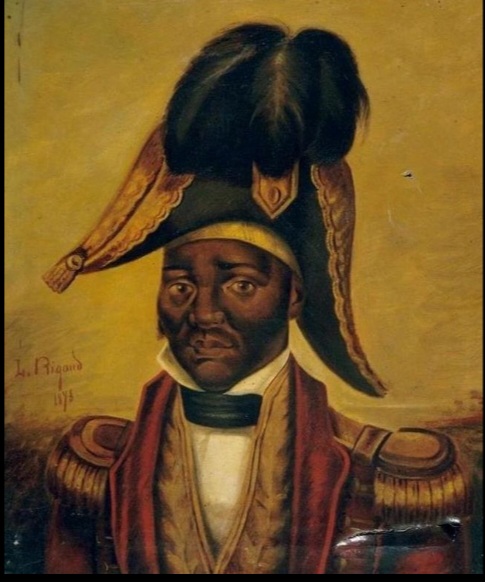
Jean-Jacques Dessalines born a slave on the French slave colony of Saint-Domingue (modern-day Haiti) around 1758. Dessalines’s early life was brutal and was marked by the inhumane realities of the slave plantation system. His original name was Duclos, he was named after the owner of the plantation where he was enslaved, information of his family is unclear, and exact birthplace are somewhat unknown, but it is believed his parents were of Congolese origin. He was later sold to a free black man named Dessalines, whose surname he adopted. It is believed that Dessalines endured harsh treatment during his enslavement, the physical and mental scars of which he carried throughout his life. This period of his life undoubtedly shaped his deep-seated hatred for slavery and his resolve to see it eradicated.
The Haitian Revolutionary

In 1788 the French Revolution sent ripples across the Atlantic Ocean, helping to fan the flames of freedom for the enslaved people in Saint-Domingue. In 1791, a massive slave rebellion erupted in the northern plain, marking the beginning of the Haitian Revolution. Dessalines would join the growing insurgency of enslaved freedom fighters, he initially served under leaders like Jean-François Papillon and Georges Biassou. His military prowess and ferocity in battle quickly became apparent, earning him the moniker “the Tiger.” Dessalines’s righteous path soon intertwined with that of another righteous warrior, Toussaint Louverture, who himself was also a brilliant former slave and freedom fighter who rose to prominence within the revolutionary ranks. Dessalines became Louverture’s principal lieutenant, playing a crucial role in numerous campaigns against the French, Spanish, and British forces vying for control of the lucrative colony. Their joint efforts were instrumental in the expulsion of foreign powers and the eventual control of the entire island by the formerly enslaved.
Freedom Fighter And Family Man
Dessalines would marry a woman named Marie-Claire Heureuse Félicité Bonheur. She would later become the first Empress of Haiti. Dessalines also had siblings who participated in the revolutionary struggle, and his nephews later held positions of note in the Haitian government after independence.
The Black Emperor of Haiti

In the Aftermath of the capture and deportation of Toussaint Louverture by French forces in 1802, Dessalines stepped up to become the leader of the revolution. He recognized Napoleon Bonaparte’s objective was to re-establish slavery on the small but economically lucrative Caribbean island. Dessalines would use that knowledge as motivation to galvanize the remaining revolutionary forces, uniting black and mulatto factions against the common enemy. His leadership culminated in the decisive victory over the French at the Battle of Vertières in November 1803. On January 1, 1804, Dessalines, in his role as governor-general, declared the independence of Saint-Domingue, later renaming the former slave colony Haiti, a name which is derived from the indigenous Taino language. This act was a monumental defiance of colonial power and a beacon of hope for enslaved people worldwide. Later that year, in October 1804, in a move that mirrored Napoleon’s own consolidation of power, Dessalines was declared Emperor of Haiti, taking the title Jacques I. His rule, as enshrined in the 1805 constitution, was highly centralized and authoritarian, driven by the need to secure the nation’s independence and prevent the return of slavery. Dessalines would implement new policies aimed at rebuilding the economy, primarily through forced labor on plantations, a controversial measure that drew criticism even from his allies.
His Death
Dessalines’ autocratic rule and his new political policies helped create dissent among the elitists of Haiti, especially among the mulatto leadership who had also played a significant role in the revolution. Tensions escalated as Dessalines sought to consolidate his power and address the economic challenges facing the newly freed nation. On October 17, 1806, while en route to suppress a revolt, Jean-Jacques Dessalines was ambushed and assassinated at Pont-Rouge, near Port-au-Prince. His death was the result of a conspiracy involving some of his former comrades-in-arms, including Alexandre Pétion and Henri Christophe, who would subsequently divide the country into a southern republic and a northern kingdom.
His Legacy
Jean-Jacques Dessalines’s legacy is complex and contradicting. He was revered as a founding father and the liberator of Haiti, he is credited with the unwavering determination that secured independence and the permanent abolition of slavery. His declaration of independence remains a powerful symbol of black liberation and self-determination. The Haitian national anthem, “La Dessalinienne,” is named in his honor.
However, his reign as Emperor and the violence that characterized it, including the massacre of remaining white French residents following independence, have drawn significant criticism among some historians. Some academics view his actions as necessary to prevent the re-establishment of slavery and French control of the small island nation, while others condemn them as brutal excesses. Despite his many controversies, Dessalines’ place in history as the leader who saw the Haitian Revolution through to its successful conclusion and established the first independent black nation in the Western Hemisphere is undeniable. His courage and leadership in overcoming seemingly insurmountable odds continue to inspire, making him a crucial figure in the history of the Americas and the global struggle against oppression.
For Additional Information And Sources Use Links Below:
Jacques_Dessalines
https://www.britannica.com/biography/Jean-Jacques-Dessalines
https://www.blackpast.org/global-african-history/dessalines-jean-jacques-1758-1806/
https://www.biography.com/political-figures/jean-jacques-dessalines



Leave a Reply