
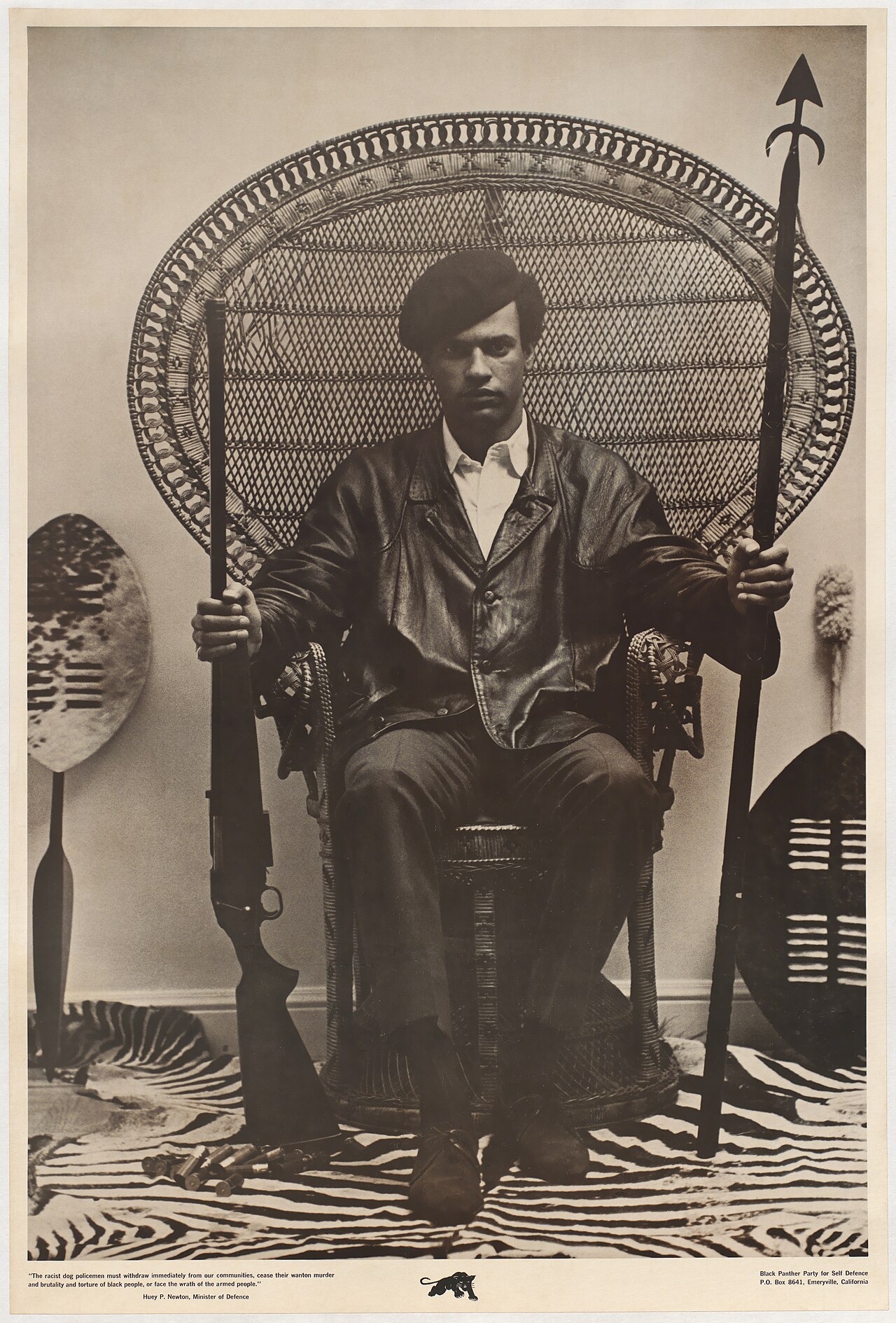

By: Leon Kwasi Kuntuo-Asare
Origins: Childhood and Education
Huey Percy Newton was born in Monroe, Louisiana, on February 17, 1942, he was the youngest of seven children. His family, like so many other Black families during that period, migrated away from the segregated and impoverished south during the period of the Great Migration, looking for their tiny piece of the American dream. Eventually they settled in Oakland, California. Even though he graduated from Oakland Technical High School in 1959, Newton was functionally illiterate. This experience deeply shaped his understanding of how the system failed his people .
Newton later wrote in his autobiography, “Revolutionary Suicide” :
“During those long years in Oakland public schools, I did not have one teacher who taught me anything relevant to my own life or experience. Not one instructor ever awoke in me a desire to learn more or to question or to explore the worlds of literature, science, and history. All they did was try to rob me of the sense of my own uniqueness and worth, and in the process nearly killed my urge to inquire.”

He eventually reached a turning point in his student life when he forced himself to learn to read, famously starting with Plato’s Republic. His newly gained ability to read unlocked a new hunger for literary knowledge. After high school Newton would enroll at Merritt College in Oakland, there, he study law and philosophy. It was at Oakland’s Merritt College that his political consciousness was forged. There he would meet Bobby Seale, and the two future Black revolutionaries would become deeply involved in local activism, protesting the college’s curriculum and demanding the inclusion of Black history courses.
BLACK ✊🏿 PANTHER

On October 15, 1966, Newton and Seale founded the Black Panther Party for Self-Defense (BPP) in Oakland, California. The party was specifically created as a direct response to rampant police brutality and systemic white supremacy. Newton would serve as the party’s Minister of Defense, he would draw from his legal studies to craft the party’s initial platform.

The ideology of Newton and Seale’s new organization was clarified in the Ten-Point Program, a set of demands that became the BPP’s foundational document. It outlined what the party wanted and believed, including:
We Want Freedom. We Want Power To Determine The Destiny Of Our Black Community.
We Want Full Employment For Our People.
We Want An End To The Robbery By The Capitalist Of Our Black Community.
We Want Decent Housing, Fit For The Shelter Of Human Beings.
We Want Education For Our People That Exposes The True Decadent Nature Of This American Society.
We Want An Immediate End To POLICE BRUTALITY And MURDER Of Black People.
The party gained national attention by openly and legally carrying firearms in the state of California, a practice Newton justified as a necessary act of self-defense against a hostile state. However, while the mainstream media was focused on the Panthers’ guns and militant speeches, the core of their work was what Newton called “survival programs.” These survival programs were designed to meet the immediate needs of the Black community. The most famous of these programs was the Free Breakfast for School Children Program. Which was launched in Oakland in 1969, the program provided free, nutritious breakfasts to thousands of children every day before school. The Panthers’ Free Breakfast Program was so effective that it shamed the United States government, which later expanded its own national school breakfast program as a direct result.
The Black Panthers community survival programs also included:
Free health clinics providing medical and dental care.
Sickle-cell anemia testing.
Free transportation services for families visiting incarcerated relatives.
The Oakland Community School, which provided a high-level, liberation-focused education for children.
Newton’s Biography

In Newton’s 1973 autobiography
“Revolutionary Suicide,” he articulated the core philosophy that he used to guide his life’s mission. He explained the difference between “reactionary suicide”—giving up in the face of oppression—and “revolutionary suicide,” which he defined as the willingness to risk death in the fight for freedom. He argued that to be a true revolutionary was to accept that one’s life was already forfeit in the struggle against a system that would inevitably seek to destroy you.
The Trials of Newton

In October of 1967, Newton was involved in a traffic stop that would result in the death of Oakland police officer John Frey and injuries to Newton and another officer. Newton would be charged with murder, in response the BBP, alongside other activists would rally behind the Black Power leader, both in the United States and across the world. The slogan “Free Huey” echoed at protests around the world. In 1968; he was convicted of voluntary manslaughter and sentenced to 2-15 years in prison. While incarcerated, Newton spent much of this time alone in solitary confinement, however, his influence and his myth would only grow larger during his time behind bars. In 1970, Newton was released after his conviction was overturned on appeal due to procedural errors. After two subsequent mistrials, the charges were ultimately dropped.
BLACK POWER AMBASSADOR

Chinese Premier Zhou Enlai
Shortly after getting released from prison, in September 1971, Newton alongside other Panther companions, ( Elaine Brown and Robert Bay ) visited China a year before President Richard Nixon’s historic trip to the country. The reason for the trip was partly to showcase international solidarity for the Black Panther Party and for the BPP could gain some inspiration from the country’s revolutionary principles. Newton was also impressed by the Chinese system of minority groups having both control of their communities and full access to public facilities.

After his release from prison, Newton fully embraced his role as the BPP’s ideological leader, and the voice of the Black Power Movement, earning a Ph.D. from the social philosophy program of History of Consciousness from the University of California at Santa Cruz in 1980.
Death and Legacy

Despite his achievements as an academic and activist; his later life was marked by internal party conflicts, persistent illegal government surveillance and harassment under the FBI’s COINTELPRO, and personal struggles with drug addiction and further legal troubles. On August 22, 1989, Huey P. Newton was shot and killed in West Oakland, not far from where the Black Panther Party was born. Tyrone Robinson, a career-criminal was arrested and later sentenced to 32-years in prison for the murder. Newton’s death marked the end of a revolutionary and sometimes chaotic life. However, his legacy is undeniably Black, Beautiful and Powerful. Huey P. Newton and the Black Panther Party fundamentally shifted the conversation on civil rights, moving it from a plea for integration to a demand for self-determination and power. The survival programs he created provided a tangible blueprint for community-based care that inspires activists to this day.
For Additional Information And Sources Use Links Below:
https://en.wikipedia.org/wiki/Huey_P._Newton?hl=en-US#:~:text=During%20his%20time%20at%20Merritt,Newton%20became%20minister%20of%20defense
https://www.oxfordbibliographies.com/display/document/obo-9780190280024/obo-9780190280024-0097.xml?hl=en-US#:~:text=He%20graduated%20from%20Oakland%20Technical,of%20political%20discussion%20and%20activism.
https://hueypnewtonfoundation.org/advocacy?hl=en-US
https://blackpast.org/african-american-history/black-panther-partys-free-breakfast-program-1969-1980/?hl=en-US#:~:text=In%201973%2C%20this%20attention%20helped,children%20could%20get%20free%20lunches.
https://en.wikipedia.org/wiki/Revolutionary_Suicide?hl=en-US#:~:text=Revolutionary%20Suicide%20was%20written%20when,his%20manifesto%20and%20political%20philosophy.
https://oaklandnorth.net/2021/10/24/oakland-huey-newton-sculpture/



Leave a Reply