
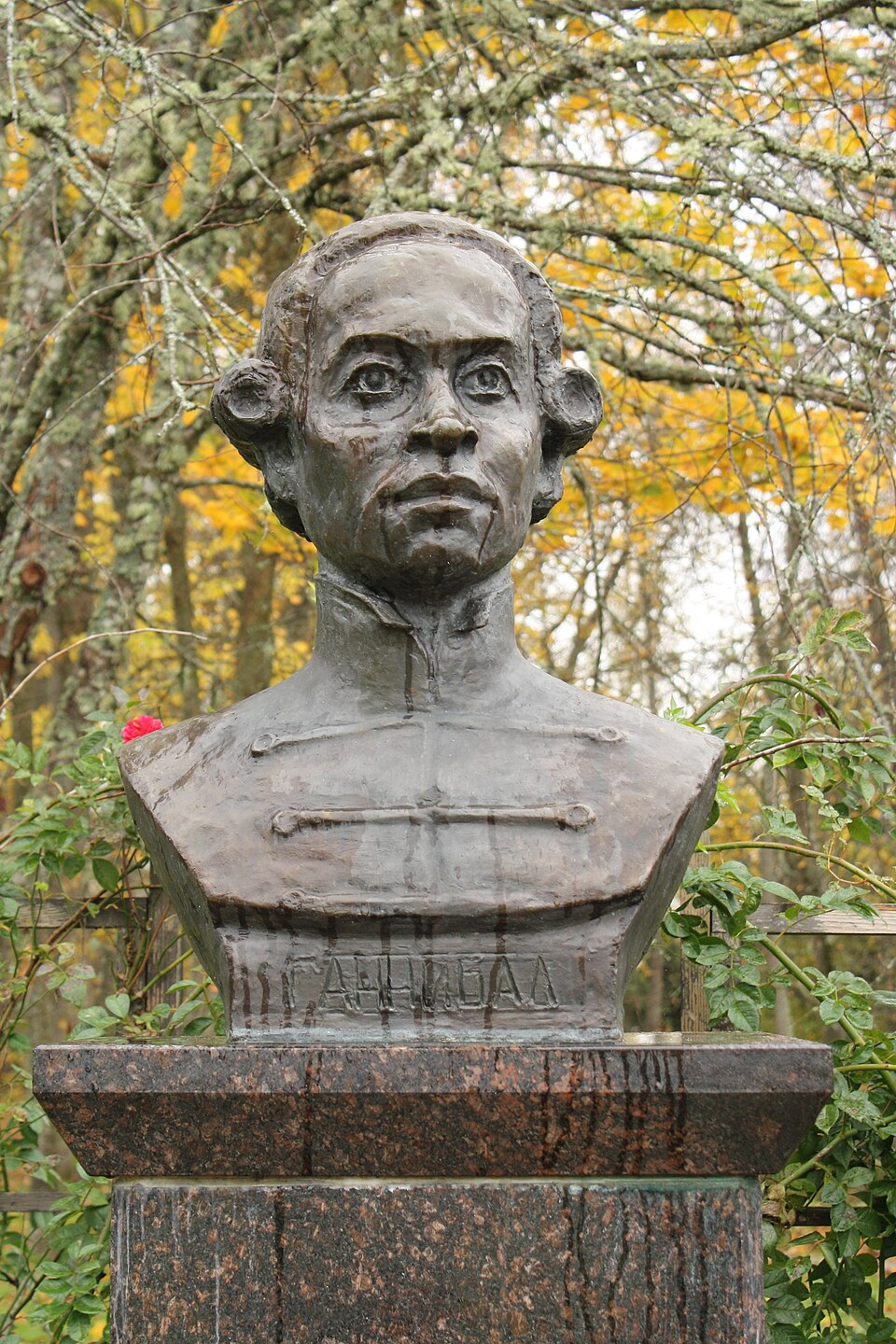

By: Leon Kwasi Kuntuo-Asare
Origins
It is believed that Abram Petrovich Gannibal was born sometime in the late 1690s. He was of African origin,
some historians theorize he may of been born in modern-day Cameroon or Ethiopia. Some believe he may have been the son of a minor African chief. As a young child, he was captured, either through war or the slave trade, and eventually brought to Constantinople (in Modern-day Turkey). It was in the Ottoman capital that he came to the attention of the Russian ambassador, Sava Vladislavich-Raguzinsky, who purchased him as a slave and brought him to Moscow in 1704 as a gift for Tsar Peter the Great.
Peter who was more open-minded than most people of his time, had Abram brought into his household, where he was baptized into the Orthodox Christian faith in 1705, with Peter himself acting as his godfather. This pivotal event not only gave him the patronymic “Petrovich” but also formally integrated him into the Tsar’s inner circle.
while growing up in Peter’s the Great’s court, he received an education far superior than that of most Russians at the time. He traveled with the Tsar on his campaigns and journeys, serving as his valet and developing a close bond with his benefactor.
Recognizing Abram’s intelligence and potential, Peter the Great ensured he received further schooling, particularly in mathematics and geometry, subjects in which he showed a natural aptitude.
EDUCATION AND MILITARY CAREER
Peter the Great’s commitment to Abram’s educational development would lead to him sending Gannibal to France in 1717. There, he advanced his studies in the arts, sciences, and warfare. He would enroll in a military engineering school in Paris and later at the royal artillery academy in La Fère.

During his time in France, he not only excelled academically but also gained practical military experience, he even fought in the War of the Quadruple Alliance and rose to the rank of captain in the French army. It was in France that he adopted the surname Gannibal, in honor of the Carthaginian general Hannibal, a figure he reportedly admired. when he returned to Russia in 1723, Gannibal was expected to contribute his newly acquired skills to Peter the Great’s ongoing modernization efforts, particularly in the military and infrastructure.
However, upon the death of Peter the Great in 1725, a period of uncertainty took hold of Russia. Under the regency and subsequent reign of figures less favorably disposed to Peter’s proteges, Gannibal experienced a decline in his standing and was sent to Siberia in exile in 1727. During his time away in Siberia, he worked on various construction projects, including the building of a fortress.
However, his fortunes change for the better, with the accession of Peter the Great’s daughter, Empress Elizabeth, in 1741. The empress fondly remembered Gannibal from her father’s court, and restored him to favor. He quickly rose through the ranks of the Russian military, achieving the position of Major-General and being appointed Superintendent of Reval (now Tallinn, Estonia) from 1742 to 1752. In this role, he oversaw massive construction and fortification projects. Gannibal’s expertise in military engineering was highly valued. He was appointed the new chief military engineer of the Russian army in 1756 and was awarded the rank of General-in-Chief in 1759, the second-highest military rank in Imperial Russia.
In his long and accomplished career, he supervised the construction of fortresses, canals (including contributing to the Ladoga Canal), and other vital infrastructure projects that were crucial for the expansion and defense of the Russian Empire. He retired from service in 1762.
Legacy
Today, Abram Petrovich Gannibal is remembered as a skilled engineer, a loyal career military man in the Russian Empire, and a remarkable historical figure, who went from being a slave to being one of the most powerful people in the Russian Empire.

He was the maternal great-grandfather of Alexander Pushkin, who is one of the greatest poets, playwrights, and novelist of Russian literary history.
For Additional Information And Sources Use Links Below:
https://www.blackpast.org/global-african-history/hannibal-abram-petrovich-gannibal-p-1696-1781/
https://en.m.wikipedia.org/wiki/Abram_Petrovich_Gannibal
https://en.m.wikipedia.org/wiki/Alexander_Pushkin
https://worldhistoryedu.com/abram-petrovich-gannibal-life-enslavement-achievements-grandchildren/
https://kreolmagazine.com/culture/features/abram-petrovich-gannibal-a-life-changed-by-fortune/


Leave a Reply