

By: Leon Kwasi Kuntuo-Asare
Origins
Scorpion II (possibly Selk or Weha) originated from the Naqada III culture of Upper (southern) Egypt, an advanced society for the time-period that flourished along the Nile River (c.3200–3000 BCE). The culture, which was indigenous to the region, was characterized by advanced pottery, intricate burial practices, and the development of early forms of writing. The people of the Naqada culture, the ancestors of the dynastic Egyptians, were a dark-skinned African people, a fact supported by skeletal remains and the broader context of the Nile Valley’s indigenous populations. Their society was organized into several powerful proto-states, with Hierakonpolis, or “City of the Falcon,” emerging as a major center of political and religious power. It is from this crucible of African innovation that Scorpion II likely arose, a leader of one of these influential southern polities.
The Reign of a Warrior King

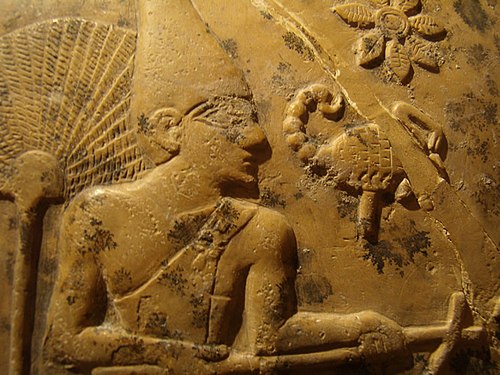
The most convincing evidence of King Scorpion II’s existence and reign comes from the gloriously designed Scorpion Macehead, a ceremonial weapon discovered at Hierakonpolis. This artifact, which is carved from limestone, depicts a king, identified by a scorpion hieroglyph, wearing the White Crown of Upper Egypt.
He is shown in a ritual act, possibly the opening of a canal or the founding of a temple, signifying his role as a provider for his people and a unifier of the land, as well as being a religious leader of his nation. The macehead stands as a testament to Scorpion II’s prowess as a military leader. It features symbols from which hang defeated enemies, symbolized by lapwing birds, representing the subjugation of other peoples or rival factions. This imagery suggests a period of intense political and military activity during this time period, with Scorpion II as the dominant force expanding his territory, political, cultural, and religious influence. His name, invoking the formidable desert creature, likely reflected his strength and power as a mighty regal African ruler. While some scholars and researchers debate the full extent of his kingdom, the presence of his name on artifacts found as far north as the Nile Delta suggests his influence was widespread. He was a key player in the final stages of the unification of Egypt as a unified state, a centuries-long endeavor by the rulers of Upper Egypt to bring the entire land under a single authority.
Scorpion II’s Legacy And Achievements

The relationship between Scorpion II and his successor, Narmer, the celebrated unifier of Upper and Lower Egypt and the first king of the First Dynasty, remains one of ancient Egypt’s most debated subjects in Egyptology and anthropology. Some scholars believe Scorpion II and Narmer were the same person, with “Scorpion” being a title or an earlier name. While others argue that they were distinct rulers, with Scorpion II being the penultimate king who paved the way for Narmer’s final victory. Another theory is that they were rivals, each competing for control of the entire Nile Valley. Regardless of the relationship between Scorpion II and Narmer, it is obvious that Scorpion II was a monumental figure in the making of Egypt, whose reign immediately preceded the dawn of the dynastic period. His military campaigns and political consolidation created the conditions necessary for Narmer to complete the unification and usher in an era of unprecedented peace, prosperity, and cultural achievement.
Though the sands of time have obscured many of the details of his life, Pharaoh Scorpion II remains a powerful symbol of the indigenous African leadership that gave rise to ancient Egyptian civilization. His story, etched in stone and whispered through millennia, is a vital chapter in the grand narrative of Black history, a testament to the enduring legacy of a king who helped lay the groundwork for one of humanity’s greatest civilizations.
Artifacts And Drawings


For Additional Information And Sources Use Links Below:
https://ancientegyptonline.co.uk/scorpion-macehead/?hl=en-US
https://en.m.wikipedia.org/wiki/Scorpion_II
https://commons.m.wikimedia.org/wiki/File:Ceremonial_mace-head_of_King_Scorpion.jpg?hl=en-US#:~:text=Captions%20Edit,mace%2Dhead%20of%20King%20Scorpion




Leave a Reply