

By: Leon Kwasi Kuntuo-Asare
Origins
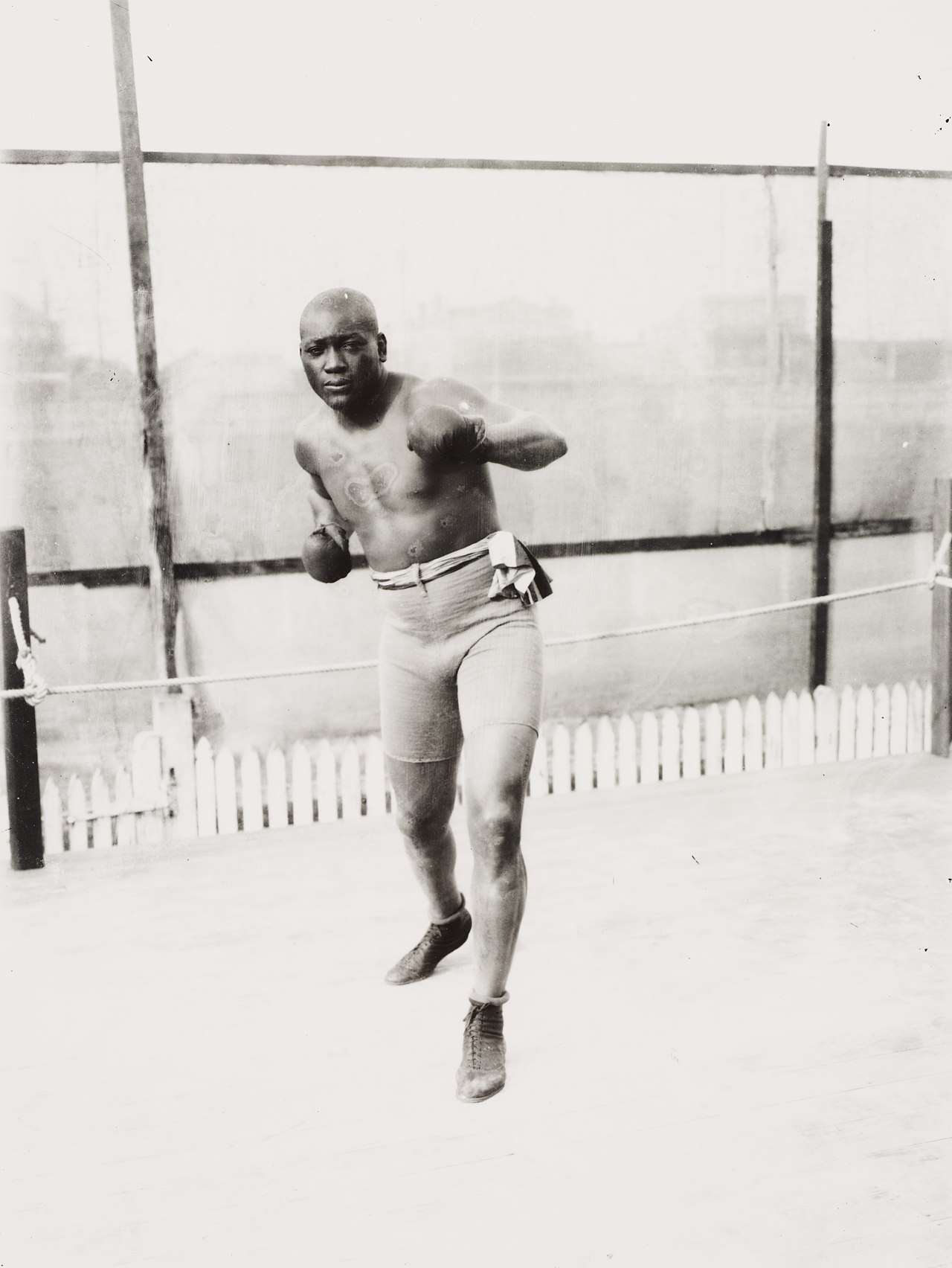
John (Jack) Arthur Johnson was born on March 31, 1878 in Galveston, Texas. Johnson was the third of nine children of Henry and Tina Johnson, who were both former slaves, who worked hard menial jobs to support their family. Johnson’s father served as civilian teamster of the Union Army’s 38th colored infantry, and had an atrophied right leg, which occurred in the Civil War.
Johnson quit school after only a handful of years and began working at the docks in his area. Johnson would move to Dallas, Texas, and found work as an apprentice for a painter named Walter Lewis. Lewis was an avid boxing fan and even had friends who were boxers, whom he would watch spar whenever possible. Johnson would credit Lewis as the reason he became a boxer.
At the age of 16, Johnson moved to New York City, and lived with a boxer named, Barbados Joe Walcott, who was a West Indian welterweight boxer. Johnson would earn a living exercising horses for a nearby horse stable. Unfortunately, Johnson would be fired after being accused of exhausting a horse. Johnson would return to Galveston, Texas, and would find work as a janitor in the boxing gym of heavyweight boxer, Herman Bernau, where he would also compete in several “smoker” fights in the summer.
THR Pugilist Warrior

Johnson would make his professional boxing debut on November 1, 1889, in his hometown of Galveston, Texas. In that fight, Johnson scored a 2nd round knockout in a match that was scheduled for 15 rounds. On February 25, 1901, Johnson had a boxing match against a man named Joe Choynski, also in his hometown of Galveston. Choynaski, who was a local heavyweight boxing hero , knocked out Johnson in the third round. Because professional prizefighting was illegal in Texas at the time, the two men were arrested. Once in jail, Johnson would learn how to properly train the “sweet science” from Choynski. The two men would become friends in jail and would remain friends after they were released. Ultimately, a grand jury would refuse to indict either men, and the charges would be dropped.
Over time, Johnson would create his own style of boxing, which was considered revolutionary for the time. He devised a strategy of striking his opponent first and counter striking them as they retaliated. Over a century later, MMA hall former and UFC middleweight champion Anderson and boxing hall of famer and multi-division world champion Floyd Mayweather Jr. would utilize a similar style to become all-time greats in their respective disciplines.
On October 21, 1902, Johnson climbed the boxing ranks by beating former (Black division) heavyweight boxing champion, Frank Childs. By 1903, Johnson had won over 50 boxing bouts, even though many of the fights were unsanctioned and therefore unofficial. On February 3, 1903, Johnson outpointed Denver Ed Martin to win the World Colored Heavyweight Championship. Johnson held onto the title until he vacated it after he won the (integrated) Heavyweight World Championship from Tommy Burns in Sydney, Australia on Boxing Day of 1908.
The world seeing Johnson, a Black man, who was the son of two former slaves, defeat Burns a White man, caused much hatred amongst White society. Many white men prayed and hoped that a “Great White Hope” would ultimately defeat Johnson for the title.
During his time as World Champion, Johnson was both the world’s most famous and infamous Black man in the country. Johnson was covered by all the major media companies of the time, including the New York Times, who wrote this before his world championship boxing match:
“If the black man wins, thousands and thousands of his ignorant brothers will misinterpret his victory as justifying claims to much more than mere physical equality with their white neighbors. If the negro loses, the members of his race will be taunted and irritated [provoked] because of their champion’s downfall.”
Fight of The Century

In 1910, former unbeaten heavyweight champion, James J. Jeffries came out of retirement for the sole-purpose of removing the world title from the waist of a Black man. Leading up to the fight, Jeffries allegedly said:
“I am going into this fight for the sole-purpose of proving that a White man is better than a Negro”.
The anti-black racial tension was so high, that guns, knives, and pretty much anything that could be used as a weapon was barred from the fight venue, even the sell of alcohol or people believed to be under the influence of alcohol were not allowed in the arena.
By round 15, Jeffries had been beaten and battered and knocked down several times, his corner fearing he would be killed in the ring by Johnson, threw in the towel. For the “Fight of The Century”, Johnson was paid $65,000 (which converts to about $1.8 million in 2019 dollars).
A Black man dominating a White man on the sports world stage caused many white men to lash out at innocent Black people. On the 4th of July, race riots occurred all across the country, in areas like New York, Washington D.C., Texas, and Colorado, just to name a few locations. On the other hand, Black people celebrated Johnson’s victory and viewed it as advancement for the Black race.

Angry white mobs started race riots in 25 states and at least 50 cities, reportedly killing over 20 people and injuring hundreds more (most likely those numbers are understated) and the true numbers are most likely much higher. The White man’s morale was so down after the fight, White politicians banned the distribution of all prizefighting moving pictures (films) across state lines from 1912 to 1940, when the ban was finally lifted.
On December 19, 1913, Jack Johnson fought another Johnson, battling Jim Johnson in Paris, France. It was the first time two Black men fought each other for the now-integrated World Heavyweight boxing title. The fight was a 10-round lackluster draw, and Johnson retained his belt. Johnson later claimed he was injured. Therefore, he was unable to perform to the best of his abilities.
No Longer World Champion
Johnson would eventually lose his world title on April 5, 1915 to a man named, Jess Willard.

Even though Johnson held the edge in several of the early rounds of the bout, he began to show signs of being fatigued as the fight went into the later rounds. Johnson would be knocked out in the 26th round of a 45-round fight. Johnson continued to fight until the late 1930s, when he was 60 years old, and had lost 7 of his last 9 fights, losing his last fight by 7th-round TKO to Walter Price.
Outside of Boxing And Later In Life
Johnson was one of the first Black athletes to earn a small fortune by getting endorsement deals for various products, including medicine. Johnson also put his life in danger by entering into several marriages with White women.

This infuriated white society so much, that they decided to target Johnson with the Mann Act, which was a law that made it a felony to transport a woman across state lines for immoral purposes, which many white people would consider a Black man being married to, or in a relationship with a white woman.
Death And Legacy
Johnson was involved in a devastating car crash on June 10, 1946, on U.S. Highway 1, around Franklinton, North Carolina. After the crash, Johnson was taken to the nearest all-black hospital, Saint Agnes Hospital in Raleigh, North Carolina, where he would die, he was only 68 years old. In 1954, Johnson was inducted into the Ring Magazine Boxing Hall of Fame, in 1993 Johnson was inducted in the International Boxing Hall of Fame.
Jack Johnson would be posthumously pardoned by President Donald Trump in 2018.

For Additional Information Use Links Below:
https://en.m.wikipedia.org/wiki/Jack_Johnson_(boxer)#
https://en.m.wikipedia.org/wiki/Johnson%E2%80%93Jeffries_riots
https://www.britannica.com/biography/Jack-Johnson
https://nmaahc.si.edu/explore/stories/jack-johnson-heavyweight-boxer-defied-america


Leave a Reply