
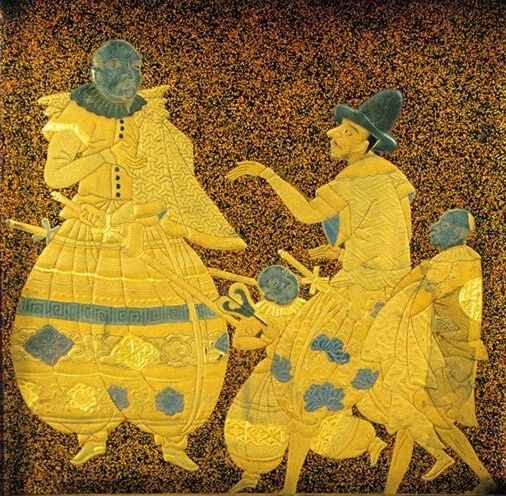

By: Leon Kwasi Kuntuo-Asare
Origins
Yasuke is believed by some scholars to of come from the Yao people of modern-day Mozambique. Therefore some believe his name Yasuke derived from “Yao-Suke”, suke being a Japanese suffix added to a male name, so Yasuke most likely meant a man of Yao origin. There are varying accounts saying he could of been Ethiopian, or from Sudan, but no one knows for sure.
ARRIVAL IN JAPAN

It is documented that when Yasuke arrived in Japan in 1579, he was in the service of an Italian Jesuit Missionary named, Alessandro Valignano, who was appointed by the society of Jesus (Jesuits), to inspect their missions in East Africa, South and East Asia.

For the Japanese who encountered him, it would of been their first time seeing a Black man. The Jesuits later reported when Yauke was taken to Oda Nobunaga, head of the powerful Oda clan (a man some scholars of Japanese history credit as being one of the first unifiers of Japan), the Daimyo (feudal lord) thought that Yasuke had been painted with black ink and ordered Yasuke to remove his clothes from the waist up and demanded he scrub his skin to attempt to remove what he assumed was black ink painted on his skin.

Reportedly when Nobunaga realized that Yasuke was not wearing ink, but instead was a Black man, he became fascinated with the African, and praised him for his strength and demeanor. It has been written that Nobunaga’s nephew gave Yasuke some money after their first meeting to help him on his journey.
BLACK SAMURAI
On May 1581, Yasuke left for a trip with some other Christians to go to the Echizen province. There they would meet with regional warlords Shibata Katsuie,Hashiba Hidekatsu and Hashiba Hidekatsu. When Yasuke and his fellow Christian missionaries returned to Kyoto (the former capitol of Japan) on May 30, at some point afterwards Yasuke entered into the service of Nobunaga. Nobunaga would also give Yasuke his own residence , a ceremonial katana and would make him his weapons bearer. In the Battle of Tenmokuzan, Nobunaga led his forces (which included Yasuke) into armed conflict and ultimately victory against the Takeda clan. On June 1582, Nobunaga was attacked by the army of Akechi Mitsuhide. Yasuke was present at the time of the attack and he fought with valor against Akechi’s forces, but ultimately Nobunaga forces would be overwhelmed and Nobunaga would be forced to commit seppuku (ritual suicide). After the death of Nobunaga, Yasuke visited Nobunaga’s son and heir apparent Oda Nobutada, who at the time was in the process of rallying forces at Nijo castle. Yasuke fought bravely alongside Nobutada’s forces, but was ultimately captured. When Yasuke was brought to Akechi, the warlord reportedly made racist comments about Yasuke being an animal and not Japanese, therefore he stated that Yasuke shouldn’t be killed, but rather taken to the Christian church in Kyoto. His ultimate fate is unknown and there is no more written about him after this time. Some people believe he may of returned to working for the Catholic Church, or contracted his services to other warlords.
Yasuke Statues On Display





Leave a Reply